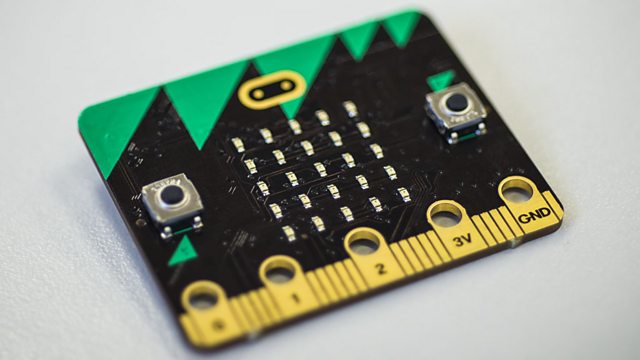
Yes, folks,I decides to raid the piggy bank a little and get a BBC Micro:bit from those rather lovely people at "Technology Will Save Us!":
As well as the basic package, they give you a few bits to play around with. However, they don't give you a prototyping board, which would have been handy, but you can get those from Maplin. It looks pretty and when you plug it in to the battery pack it does a little start up routine that's pretty awesome for such a small device. Cute!
... about programming, growing up in the 1970's and 80's, games, science fiction, working in a charity book shop, films, spending too much time watching television, living in Basildon and Essex, and whatever else emerges from my fevered imagination. If you're reading this, it's your fault you clicked on the link: I am not responsible for your actions.
Showing posts with label Internet of Things. Show all posts
Thursday, 20 October 2016
Tuesday, 24 November 2015
IoT Innovators Meetup: Meet the BBC micro:bit with Howard Baker
It's been a while since I attended any hardware meetups and so I went along to a new group meeting at Canonical (the organisation behind Ubuntu) on London's South Bank, behind Tate Modern. Nice offices:
The presentation was given by Howard Baker who is a lead at BBC Learning looking at innovating technologies.
His talk was about the background to the micro:bit, the BBC's initiative to promote software development in schools through a micro device.
It turns out that software development is not taught at schools, something that astounded me (A-Level at least...) and that Universities complain that the entrants to Computer Science courses have to be taught basic programming skills. In answer to this. the current Director General of the BBC wants an initiative to promote programming, in the same way the Model B did all those years ago. Everyone has a computer these days so, after a few false starts, Howard and his team came up with the micro:bit. It has a small ARM chip, a magnetometer, accelerometer and a neat 5 X 5 led display, along with a low power blu-tooth transmitter/receiver. It also has a mini-USB port and external analogue/digital connector.
It's also got a nice web site with on-line editors for producing code to run the hardware, one in a Scratch-like block language, which translates into Microsoft's Touch Develop language, and one for JavaScript. There will, hopefully, be a Python one as well.
The goal is to roll out the device to 1 million children of 11-12 year old's (1st year secondary). Howard emphasised the social aspects of the program, saying that it wasn't just aimed at the children but that the parents could see their children being creative and enthusiastic. In particular, he said that he thought that the idea of owning the technology and making it themselves was fundanental, turning children "from consumers into creators", being influenced to some extent by the Maker movement.
Overall, it was an excellent presentation on an engaging subject, expecially for anyone who tried to play Elite on a Model B. So if you want a look at the future of technology, it will be available from a teenager near you.
After the presentation, I took a few snaps of the buildings around the river, all lit up.
Very festive.
The presentation was given by Howard Baker who is a lead at BBC Learning looking at innovating technologies.
His talk was about the background to the micro:bit, the BBC's initiative to promote software development in schools through a micro device.
It turns out that software development is not taught at schools, something that astounded me (A-Level at least...) and that Universities complain that the entrants to Computer Science courses have to be taught basic programming skills. In answer to this. the current Director General of the BBC wants an initiative to promote programming, in the same way the Model B did all those years ago. Everyone has a computer these days so, after a few false starts, Howard and his team came up with the micro:bit. It has a small ARM chip, a magnetometer, accelerometer and a neat 5 X 5 led display, along with a low power blu-tooth transmitter/receiver. It also has a mini-USB port and external analogue/digital connector.
It's also got a nice web site with on-line editors for producing code to run the hardware, one in a Scratch-like block language, which translates into Microsoft's Touch Develop language, and one for JavaScript. There will, hopefully, be a Python one as well.
The goal is to roll out the device to 1 million children of 11-12 year old's (1st year secondary). Howard emphasised the social aspects of the program, saying that it wasn't just aimed at the children but that the parents could see their children being creative and enthusiastic. In particular, he said that he thought that the idea of owning the technology and making it themselves was fundanental, turning children "from consumers into creators", being influenced to some extent by the Maker movement.
Overall, it was an excellent presentation on an engaging subject, expecially for anyone who tried to play Elite on a Model B. So if you want a look at the future of technology, it will be available from a teenager near you.
After the presentation, I took a few snaps of the buildings around the river, all lit up.
Very festive.
Wednesday, 10 April 2013
Internet of Things
This evening, I went along to a meeting of the Internet of Things (IoT), London. This took the form of a show case of technological innovations as part of Imperial College's Urban Prototyping Festival.
There were drinks and dim-sum (nice) and it was generally urbane and hi-tech. One firm, Quick2Wire, had a set of small boards that they used to daisy-chain sensor boards together:
The board at the top, an interface board, is attached to a Raspberry Pi (very popular at the moment). Off this is a kind of "booster" board called a Port Extender, which also does some signal processing, then the next board (an A-D converter) has a light sensor. When you covered the sensor, the light bar on the interface board at the top decreased. The second extender at the bottom interfaces directly with another display, worked from the PC attached to the Pi. The advantage of using the Raspberry Pi, as the chap doing the demonstration told me, was that it could multi-thread these two tasks as it was running Linux.
Another display was from the Open University. This showed the contents of their My Digital Life course, which looks pretty cool.
Students are provided the hardware and download a version of MIT's Scratch, which I mentioned in a previous entry, to program. All-in-all, quite impressive.
I had a quick walk around and had a brief look at the other displays, but they were very much of a muchness. It was all a little bit mundane; middle class and domestic, I thought (more than a few projects were for energy saving). I had thought that the future would be a little grander than this. Maybe when the technology got smaller, the ideas did too?
As for whether these things will result in a resurgent U.K. economy, it's worth remembering that the bulk of these (all the above, for example) are made in China. Only Arduino boards are made elsewhere (Italy). Again, as so often in our history, we may have the ideas, but others will take them and build on them. In the past that was America, now it's the Far East.
There were drinks and dim-sum (nice) and it was generally urbane and hi-tech. One firm, Quick2Wire, had a set of small boards that they used to daisy-chain sensor boards together:
The board at the top, an interface board, is attached to a Raspberry Pi (very popular at the moment). Off this is a kind of "booster" board called a Port Extender, which also does some signal processing, then the next board (an A-D converter) has a light sensor. When you covered the sensor, the light bar on the interface board at the top decreased. The second extender at the bottom interfaces directly with another display, worked from the PC attached to the Pi. The advantage of using the Raspberry Pi, as the chap doing the demonstration told me, was that it could multi-thread these two tasks as it was running Linux.
Another display was from the Open University. This showed the contents of their My Digital Life course, which looks pretty cool.
Students are provided the hardware and download a version of MIT's Scratch, which I mentioned in a previous entry, to program. All-in-all, quite impressive.
I had a quick walk around and had a brief look at the other displays, but they were very much of a muchness. It was all a little bit mundane; middle class and domestic, I thought (more than a few projects were for energy saving). I had thought that the future would be a little grander than this. Maybe when the technology got smaller, the ideas did too?
As for whether these things will result in a resurgent U.K. economy, it's worth remembering that the bulk of these (all the above, for example) are made in China. Only Arduino boards are made elsewhere (Italy). Again, as so often in our history, we may have the ideas, but others will take them and build on them. In the past that was America, now it's the Far East.
Subscribe to:
Posts (Atom)