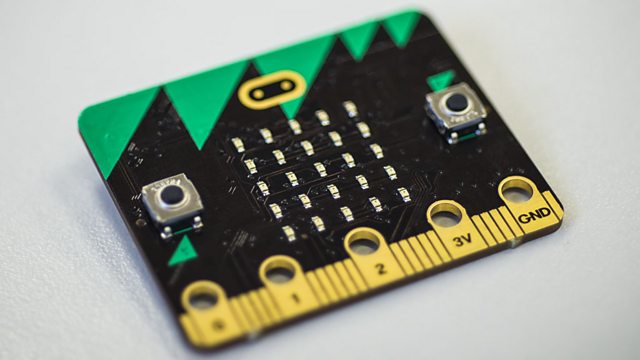
Yes, folks,I decides to raid the piggy bank a little and get a BBC Micro:bit from those rather lovely people at "Technology Will Save Us!":
As well as the basic package, they give you a few bits to play around with. However, they don't give you a prototyping board, which would have been handy, but you can get those from Maplin. It looks pretty and when you plug it in to the battery pack it does a little start up routine that's pretty awesome for such a small device. Cute!
... about programming, growing up in the 1970's and 80's, games, science fiction, working in a charity book shop, films, spending too much time watching television, living in Basildon and Essex, and whatever else emerges from my fevered imagination. If you're reading this, it's your fault you clicked on the link: I am not responsible for your actions.
Showing posts with label BBC. Show all posts
Thursday, 20 October 2016
Tuesday, 24 November 2015
IoT Innovators Meetup: Meet the BBC micro:bit with Howard Baker
It's been a while since I attended any hardware meetups and so I went along to a new group meeting at Canonical (the organisation behind Ubuntu) on London's South Bank, behind Tate Modern. Nice offices:
The presentation was given by Howard Baker who is a lead at BBC Learning looking at innovating technologies.
His talk was about the background to the micro:bit, the BBC's initiative to promote software development in schools through a micro device.
It turns out that software development is not taught at schools, something that astounded me (A-Level at least...) and that Universities complain that the entrants to Computer Science courses have to be taught basic programming skills. In answer to this. the current Director General of the BBC wants an initiative to promote programming, in the same way the Model B did all those years ago. Everyone has a computer these days so, after a few false starts, Howard and his team came up with the micro:bit. It has a small ARM chip, a magnetometer, accelerometer and a neat 5 X 5 led display, along with a low power blu-tooth transmitter/receiver. It also has a mini-USB port and external analogue/digital connector.
It's also got a nice web site with on-line editors for producing code to run the hardware, one in a Scratch-like block language, which translates into Microsoft's Touch Develop language, and one for JavaScript. There will, hopefully, be a Python one as well.
The goal is to roll out the device to 1 million children of 11-12 year old's (1st year secondary). Howard emphasised the social aspects of the program, saying that it wasn't just aimed at the children but that the parents could see their children being creative and enthusiastic. In particular, he said that he thought that the idea of owning the technology and making it themselves was fundanental, turning children "from consumers into creators", being influenced to some extent by the Maker movement.
Overall, it was an excellent presentation on an engaging subject, expecially for anyone who tried to play Elite on a Model B. So if you want a look at the future of technology, it will be available from a teenager near you.
After the presentation, I took a few snaps of the buildings around the river, all lit up.
Very festive.
The presentation was given by Howard Baker who is a lead at BBC Learning looking at innovating technologies.
His talk was about the background to the micro:bit, the BBC's initiative to promote software development in schools through a micro device.
It turns out that software development is not taught at schools, something that astounded me (A-Level at least...) and that Universities complain that the entrants to Computer Science courses have to be taught basic programming skills. In answer to this. the current Director General of the BBC wants an initiative to promote programming, in the same way the Model B did all those years ago. Everyone has a computer these days so, after a few false starts, Howard and his team came up with the micro:bit. It has a small ARM chip, a magnetometer, accelerometer and a neat 5 X 5 led display, along with a low power blu-tooth transmitter/receiver. It also has a mini-USB port and external analogue/digital connector.
It's also got a nice web site with on-line editors for producing code to run the hardware, one in a Scratch-like block language, which translates into Microsoft's Touch Develop language, and one for JavaScript. There will, hopefully, be a Python one as well.
The goal is to roll out the device to 1 million children of 11-12 year old's (1st year secondary). Howard emphasised the social aspects of the program, saying that it wasn't just aimed at the children but that the parents could see their children being creative and enthusiastic. In particular, he said that he thought that the idea of owning the technology and making it themselves was fundanental, turning children "from consumers into creators", being influenced to some extent by the Maker movement.
Overall, it was an excellent presentation on an engaging subject, expecially for anyone who tried to play Elite on a Model B. So if you want a look at the future of technology, it will be available from a teenager near you.
After the presentation, I took a few snaps of the buildings around the river, all lit up.
Very festive.
Monday, 2 August 2010
Sherlock and Rubicon
There have been two TV programmes recently which have caught my attention. One is very popular, prime-time fare and the other is obscure and possibly the best I've seen in a while.
Sherlock
Most of the people I've spoken to have complimented the latest adaption of Conan-Doyle's creation, transporting the Victorian sleuth and his companion into 21st century London. I've now watched it and I have to say that it's a very slick, knowing production. A sincere homage, from the Afghan War parallels to references to Study in Scarlet. The actors are good and well cast, from Martin Freeman's Doctor Watson and Mark Gattis' Mycroft Holmes to the lead played by Benedict Cumberbatch, who makes a very good Holmes. Even 221b Baker Street looks like the Victorian original.
I think that it will do until an original drama comes along, which doesn't seem to be happening any time soon. BBC drama seems to like grave robbing at the moment, ripping off The Sweeney (Life on Mars), A For Andromeda, Doctor Who, Quatermass and now Sherlock Holmes. They do it very well and it seems aimed for consumption by the American market.
If you look at the BBC web site from outside the UK, you get a totally different perspective on the organisation. Click on the TV section from outside and you don't get a list of the UK channels, what programmes are on when and how the licence fee is being spent. You get a (large) list of the commercial channels the BBC provides. The bedrock of BBC funding is the licence fee (£145 per household, per year), but the rest of the funding is increasingly coming from abroad, particularly the USA and Canada. The BBC is becoming a player, albeit a minor one, in the lucrative commercial American market. That's why Sherlock Holmes has been turned into CSI London.
Rubicon
So after that little rant, it seems a bit much for me to go on about an TV series just starting in the States. Rubicon is something you don't really get in the US, and something we used to do rather well. It's a paranoid conspiracy thriller, and a very good one it is too. The premise is very similar to an old Robert Redford film, Three Days of the Condor, but updated for the 21st Century and with a Grand Conspiracy, like the Illuminati, thrown in for good measure. It's got Peter Gerety, from Homicide and The Wire, and even Miranda Richardson (Queeney from Blackadder 2). I like it already.
Remember, you heard it here first.
Sherlock
Most of the people I've spoken to have complimented the latest adaption of Conan-Doyle's creation, transporting the Victorian sleuth and his companion into 21st century London. I've now watched it and I have to say that it's a very slick, knowing production. A sincere homage, from the Afghan War parallels to references to Study in Scarlet. The actors are good and well cast, from Martin Freeman's Doctor Watson and Mark Gattis' Mycroft Holmes to the lead played by Benedict Cumberbatch, who makes a very good Holmes. Even 221b Baker Street looks like the Victorian original.
I think that it will do until an original drama comes along, which doesn't seem to be happening any time soon. BBC drama seems to like grave robbing at the moment, ripping off The Sweeney (Life on Mars), A For Andromeda, Doctor Who, Quatermass and now Sherlock Holmes. They do it very well and it seems aimed for consumption by the American market.
If you look at the BBC web site from outside the UK, you get a totally different perspective on the organisation. Click on the TV section from outside and you don't get a list of the UK channels, what programmes are on when and how the licence fee is being spent. You get a (large) list of the commercial channels the BBC provides. The bedrock of BBC funding is the licence fee (£145 per household, per year), but the rest of the funding is increasingly coming from abroad, particularly the USA and Canada. The BBC is becoming a player, albeit a minor one, in the lucrative commercial American market. That's why Sherlock Holmes has been turned into CSI London.
Rubicon
So after that little rant, it seems a bit much for me to go on about an TV series just starting in the States. Rubicon is something you don't really get in the US, and something we used to do rather well. It's a paranoid conspiracy thriller, and a very good one it is too. The premise is very similar to an old Robert Redford film, Three Days of the Condor, but updated for the 21st Century and with a Grand Conspiracy, like the Illuminati, thrown in for good measure. It's got Peter Gerety, from Homicide and The Wire, and even Miranda Richardson (Queeney from Blackadder 2). I like it already.
Remember, you heard it here first.
Subscribe to:
Posts (Atom)